The parking mistakes most likely to fail a driving test are hitting or mounting the kerb, touching another car or object, poor observation (not checking around, or not stopping for other road users), finishing well outside the space or far from the kerb, and losing control with many back-and-forth moves. Small, controlled corrections are usually fine. Examiners mainly want safe, controlled driving with good observation.
Key takeaways
- Observation faults are as important as accuracy.
- A small correction is usually fine; losing control is not.
- Stop and wait if anyone approaches during the manoeuvre.
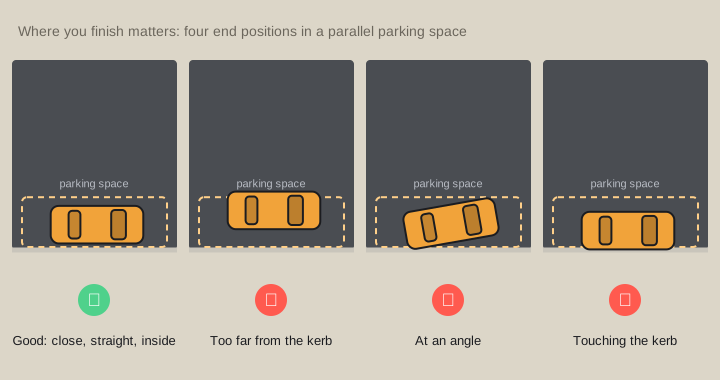
- Finish inside the space, close to the kerb and straight.
How examiners mark parking
Most tests separate small faults from serious or dangerous ones. For example, the UK test counts minor driving faults, and a single serious or dangerous fault means you fail. Hitting the kerb gently might be recorded as a minor fault, while mounting it or nearly hitting a pedestrian is far more serious. Scoring systems differ between countries, so check how your test works.
The parking mistakes that fail tests
These are the mistakes examiners most often flag during parking manoeuvres.
-
Hitting or mounting the kerb
Usually from turning in too early or reversing too fast. Go slowly and use your reference points.
-
Touching another car or object
Often the front corner swinging into the car ahead, or the rear clipping a car beside a bay. Watch both ends of your car.
-
Poor observation
Not checking blind spots, or carrying on when a pedestrian or car approaches. Look all around before and during, and stop when needed.
-
Finishing in the wrong place
Too far from the kerb, at an angle, or over the bay lines. Aim to finish close, straight and inside the space.
-
Too many corrections
Repeated shunting back and forth suggests a lack of control. Get the start position right and move slowly so one small correction is enough.
How to avoid these mistakes
- Learn the method for each manoeuvre until you know the steps without thinking.
- Find your reference points for the kerb and bay lines in your own car.
- Practise at walking pace; speed causes most accuracy faults.
- Make observation a habit: look around before every change of direction.
- Practise under test-like conditions with an instructor before the day.
Frequently asked questions
Is hitting the kerb an automatic fail?
Not always. Scoring differs by country, but a light touch is often treated as a minor fault, while mounting the kerb or losing control is much more likely to fail you.
Can I correct my position during the parking manoeuvre?
Usually yes. A small, controlled correction is normal. Many repeated corrections suggest a lack of control.
What happens if someone approaches while I am parking?
Stop and let them pass, then continue. Carrying on without reacting is a common observation fault.
How close to the kerb do I need to be?
Reasonably close and parallel without touching it. Many instructors aim for about 30 cm; check your own test’s expectations.
How can I practise parking before my test?
Learn the method, practise the sequence in a free simulator such as Parking Simulator, then practise in a real car with an instructor under test-like conditions.