To reverse bay park, drive slowly past the empty bay with about 1–1.5 m between your car and the parked cars. Stop when the bay is just behind you, check all around, then reverse slowly with full lock towards the bay. Watch both side mirrors, straighten the wheels when the car is parallel with the bay lines, and reverse straight in until you are fully inside the bay.
Key takeaways
- Reversing in is usually safer than driving in, because you drive out forwards with a clear view.
- Keep about 1–1.5 m between your car and the parked cars before you turn.
- Use both side mirrors: the bay lines should look parallel to the car on both sides.
- Go slowly. You can always stop, pull forwards a little and correct.
- Keep checking for pedestrians and other cars throughout the manoeuvre.
What is reverse bay parking?
Reverse bay parking means reversing into a marked parking space that is at a right angle (90°) to the aisle, as in most car parks. It is a common manoeuvre on driving tests. For example, it is one of the manoeuvres the examiner can ask for on the UK driving test.
Why reverse into a bay instead of driving in?
Reversing in takes a little more practice, but leaving is much safer: you drive out forwards and can see pedestrians and traffic clearly. Reversing out of a bay means backing into an aisle where your view is blocked by the cars beside you. Always follow local signs, though, as some car parks ask you to park nose-in.
How to reverse bay park in 5 steps
These steps assume the empty bay is on your right. If it is on your left, do the mirror image.
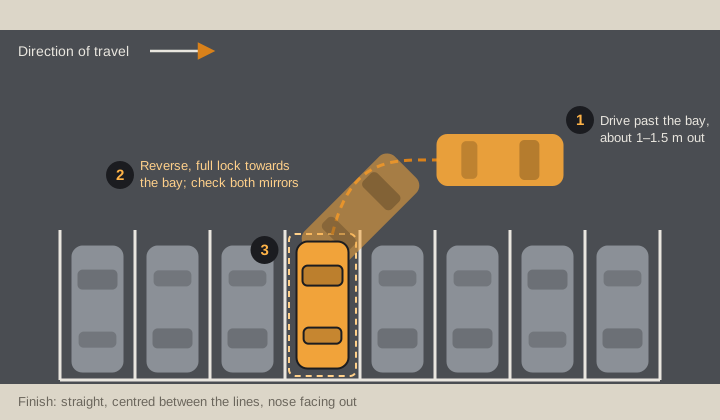
-
Slow down and position the car
Drive slowly along the aisle and pick an empty bay. Keep about 1–1.5 m between your car and the ends of the parked cars. Signal if other road users could benefit.
-
Drive past and stop
Drive past the bay and stop when it is just behind you. A common reference point is to stop when the second line after the bay is roughly level with your door mirror. The exact point depends on your car and the aisle width, so adjust it after a few tries.
Tip: Too close to the parked cars and your rear will clip them as you turn. Too far away and you will not reach the bay.
-
Reverse with full lock towards the bay
Check all around, including your blind spots, then reverse very slowly. Turn the steering fully towards the bay. Keep looking around: the front of your car swings out into the aisle as you turn.
-
Straighten when you are parallel
Watch both side mirrors. When the bay lines look parallel with the car on both sides, straighten the steering wheel.
Tip: If the gap to the line looks bigger on one side, you are not centred. Stop, pull forwards a little with the wheels straight, and reverse again.
-
Reverse straight in and stop
Reverse slowly in a straight line until the whole car is inside the bay. Use the line or kerb behind you, or the cars beside you, as a guide. Stop, apply the parking brake and select park or neutral.
Common reverse bay parking mistakes (and how to fix them)
- Starting too close to the parked carsThe rear corner of your car can hit the car beside the bay. Leave about 1–1.5 m before you turn.
- Turning too earlyThe car cuts the corner and the rear clips the line or the car on the near side. Drive a little further past before reversing.
- Turning too lateYou end up crooked or over the far line. Stop a little earlier next time.
- Forgetting the front swingWhile you reverse, the front of your car swings out into the aisle. Check that the aisle is clear on that side.
- Using only one mirrorYou cannot judge whether you are centred. Check both side mirrors as you straighten.
What do examiners look for?
Exact rules differ by country, but examiners generally look for:
- Control: a slow, steady speed and smooth steering.
- Observation: all-round checks before and during the manoeuvre, especially for pedestrians.
- Accuracy: finishing inside the bay lines and reasonably straight.
One or two small corrections are usually fine if you stay in control. For the UK test, see the official driving test guidance on GOV.UK; elsewhere, check your national driving authority.
Frequently asked questions
Is it better to reverse into a parking space or drive in forwards?
Reversing in is usually safer, because you drive out forwards with a clear view of pedestrians and traffic. Driving in forwards is quicker, but reversing out into a busy aisle is harder. Follow any local signs that require nose-in parking.
How do I know when to start turning into the bay?
A common reference point is to stop when the second line after the bay is roughly level with your door mirror, then reverse with full lock. Every car is a little different, so adjust the point after a few attempts.
How do I know if I am straight in the bay?
Check both side mirrors. When you are straight, the bay lines look parallel with your car and the gap to each line looks the same on both sides.
What should I do if I end up crooked?
Stop, pull forwards slowly with the wheels straight to realign, then reverse back in. A small correction like this is normal.
Can I practise reverse bay parking online?
Yes. Parking Simulator is a free browser-based simulator with a car park where you can practise reversing into bays between parked cars, with a score and examiner-style feedback.